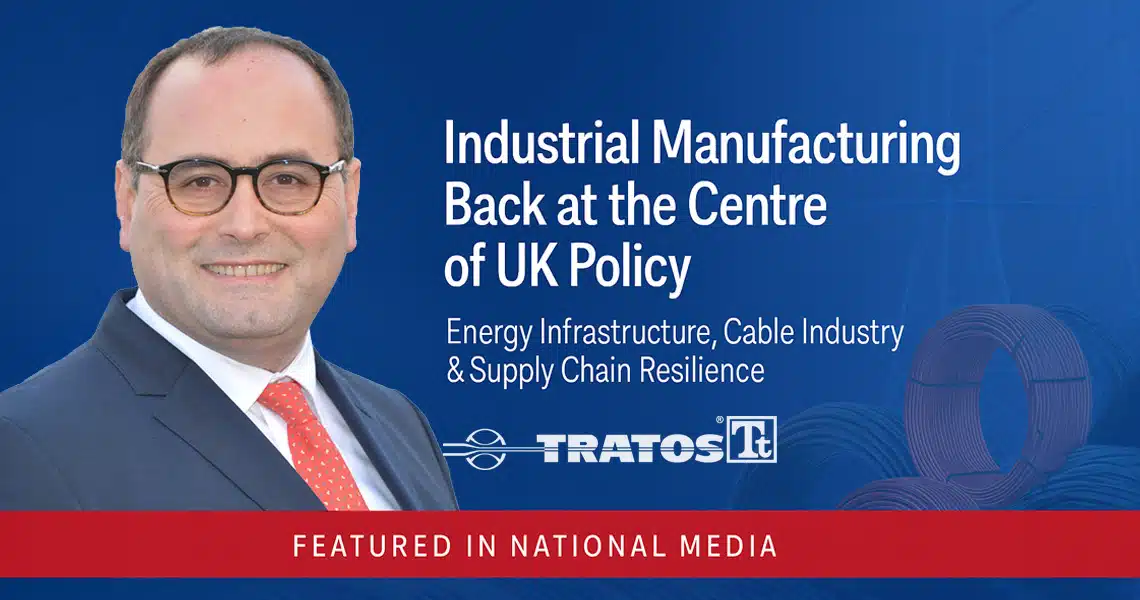
Recent national media coverage has marked a significant moment for the UK industry and for Tratos.
Following appearances on BBC Radio 4 and BBC One, the CEO of Tratos UK Ltd, Prof Maurizio Bragagni OBE, has helped bring renewed attention to a topic that is rapidly moving back up the national agenda: the strategic importance of industrial manufacturing.
Far from being routine media engagements, these interviews reflect a wider shift in thinking. Industrial leaders are once again being recognised as essential contributors to discussions on economic resilience, energy security, and infrastructure development.
A Recognised Voice in the Cable Industry
The invitation for Tratos’ CEO to contribute to the BBC’s coverage underscores the company’s position as a respected authority in the cable manufacturing sector.
At a time when the UK faces increasing challenges, from energy transition to global supply chain uncertainty, there is growing demand for expertise grounded in real industrial experience.
Tratos brings precisely that perspective. Operating at the heart of critical infrastructure, the company designs and manufactures cables that support energy networks, transport systems, and emerging technologies, sectors that are fundamental to the country’s future.
Manufacturing Returns to Strategic Importance
For many years, manufacturing was often viewed as secondary to financial services and the digital economy. Today, that perception is changing.
Recent global disruptions have exposed the vulnerability of overextended supply chains and underdeveloped domestic production capacity. As a result, policymakers, institutions, and the public are rediscovering a simple but essential reality:
This shift is particularly evident in sectors such as energy and infrastructure, where the transition to cleaner, more connected systems depends entirely on physical production, cables, metals, and engineered solutions.
Real Industry, Real Challenges
What gives weight to the Tratos perspective is its direct exposure to the realities of manufacturing.
These are not theoretical concerns, but everyday challenges, including:
- Volatility in copper and raw material markets
- Rising energy costs are affecting the UK industry
- Ongoing supply chain disruption
- Skills shortages across engineering and production
- The need to remain globally competitive while manufacturing locally
This operational experience is increasingly shaping policy conversations, both in the UK and internationally.
A Call for Action
The renewed attention on manufacturing is an important step—but it must lead to action.
For the UK, this means:
- Investing in domestic industrial capability
- Supporting competitive energy costs for manufacturers
- Strengthening resilient supply chains
- Developing the next generation of engineering and technical talent
At the same time, there is a broader need to recognise manufacturing for what it truly is: not simply production, but a foundation of national stability, innovation, and long-term growth.
As the UK navigates the challenges of energy transition, infrastructure investment, and global competition, the role of companies like Tratos becomes increasingly significant. They represent more than manufacturing output. They embody engineering expertise, industrial continuity, and a long-term commitment to building critical infrastructure.
The national conversation is changing, and manufacturing is once again at its centre. The next step is ensuring that this recognition translates into sustained support, strategic investment, and a clear commitment to securing the future of industrial capability in the United Kingdom.